

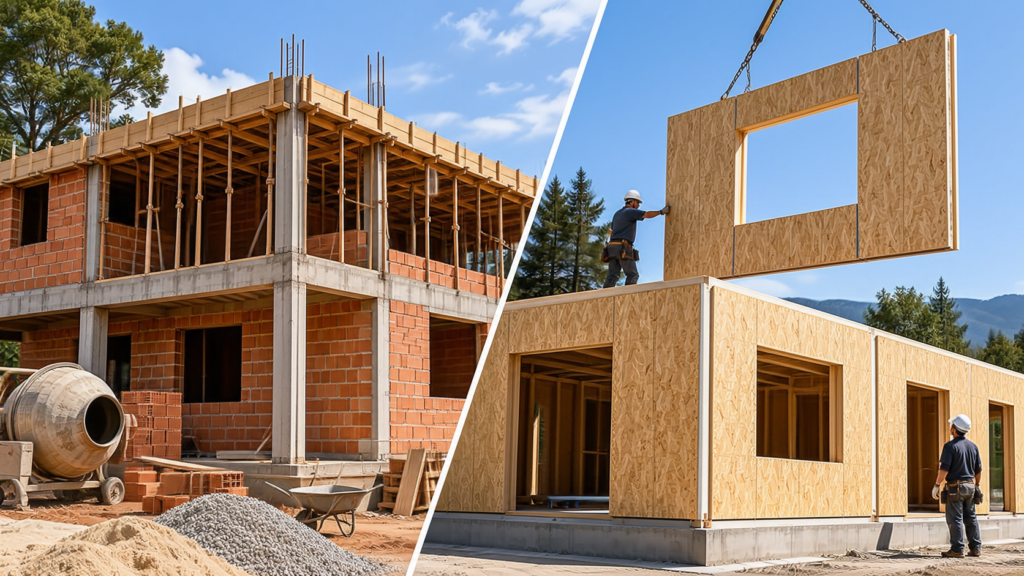
The evolution of the construction industry has expanded the possibilities for designing and building more efficient, sustainable and economically viable buildings.
While conventional construction concentrates most activities on the construction site, industrialized construction incorporates manufacturing, standardization and assembly processes using prefabricated components.
But what are the main differences between these construction methods?
Comparison of construction systems
| Criteria | Conventional construction | Industrialized construction |
|---|---|---|
| Construction time | Greater dependence on on-site activities | Potential reduction in construction time |
| Quality control | Primarily on-site | Supported by factory-controlled conditions |
| Construction waste | Greater potential for on-site waste | Potential reduction in waste |
| Thermal insulation | Depends on specified materials | Can be integrated into the system |
| Energy efficiency | Depends on the design | High potential with insulated systems and appropriate design |
| Cost predictability | Subject to variations during construction | Supported by early planning |
| Flexibility during construction | Greater opportunity for changes | Requires early design decisions |
| Initial investment | Variable | Variable |
Energy efficiency and environmental comfort
Construction systems such as Structural Insulated Panels (SIP) and solutions incorporating Expanded Polystyrene (EPS) allow thermal insulation strategies to be integrated into the building system.
When combined with architectural design that considers local climatic conditions, solar orientation, ventilation and airtightness, these systems can improve environmental comfort and reduce energy demand for heating and cooling.
How much does it cost to build, and how much does it cost to live?
The economic assessment of a building should consider not only its initial construction cost but also energy, maintenance and operating expenses throughout its service life.
One indicator used to assess building energy performance is annual energy consumption per square meter (kWh/m²/year).
After all, we know how many kilometers our cars travel per liter of fuel, but do we know how much energy our homes consume per square meter each year?
When should you choose industrialized construction?
Industrialized construction is particularly attractive for developments seeking greater predictability, streamlined construction processes and quality control.
However, its adoption requires more extensive planning during the early design stages, coordination of building services, component detailing and early material selection.
Industrialization alone does not guarantee an energy-efficient building. Factors such as solar orientation, thermal insulation, window and door performance, ventilation, airtightness and the treatment of thermal bridges are essential to building performance.
Sustainability assessments should also consider material sourcing, transportation, component durability, maintenance and energy consumption throughout the building’s service life.
LUCO’s experience in industrialized construction
In Brazil and Chile, LUCO develops architectural projects that incorporate industrialized construction systems and energy efficiency strategies.
One example is the Coquimbo Modular SIP House, a 280 m² residential model developed in partnership with the Chilean company Vaspanel, incorporating SIP panels, double-glazed windows and provisions for photovoltaic power generation and water reuse.
Explore our areas of expertise and our project portfolio in industrialized and energy-efficient architecture.
The future of construction
Industrialization represents an opportunity to transform the construction industry by incorporating innovation, productivity, energy efficiency and environmental responsibility.
The choice of construction system should consider expected performance, supplier availability, logistics, climatic conditions, costs and the characteristics of each development.
At LUCO Arquitetura e Urbanismo, we develop architectural projects that integrate these technologies while considering the specific characteristics of each development in Brazil and Chile.
LUCO Arquitetura e Urbanismo
For better cities.
Technical references
U.S. Department of Energy — Structural Insulated Panels (SIPs).