
December 6, 2021 | São Paulo City Council | São Paulo, Brazil
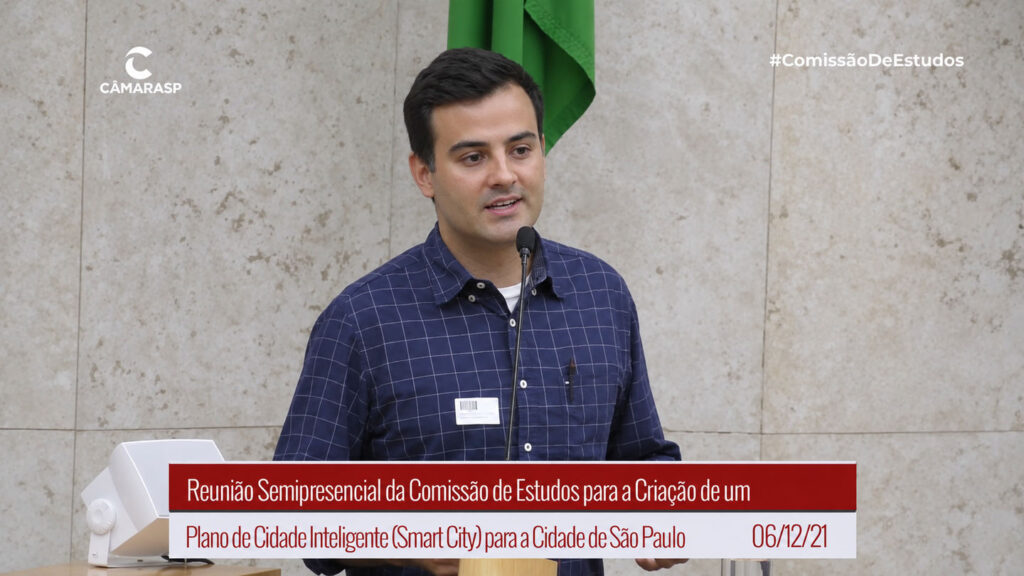
LUCO Arquitetura e Urbanismo took part in the first regular meeting of the Study Committee for the Creation of a Smart City Plan for the City of São Paulo, held at São Paulo City Council on December 6, 2021. Architect and urban planner Rodrigo Luco was invited to give a technical presentation on the potential of digital technologies to address urban challenges.
The presentation covered smart city concepts, the Internet of Things (IoT), sensors, connectivity and applications in public services. The meeting was part of discussions led by São Paulo’s municipal legislature on innovation, urban infrastructure and improving quality of life.
Smart cities beyond technology
A Smart City is not defined solely by the presence of connected devices. The concept presented by Rodrigo Luco links digital solutions to more efficient urban services, the responsible use of resources and the ability to respond to residents’ needs.
Transport networks, water supply, waste management, lighting and buildings can all benefit from more accurate information. To achieve this, digital transformation must work alongside urban and territorial planning and public administration capable of turning data into decisions and tangible improvements.
Internet of Things (IoT) and urban connectivity
One of the presentation’s main topics was the Internet of Things (IoT), which connects physical objects and devices to communication networks. Presence, motion, speed and temperature sensors, combined with processing devices and connectivity, can collect and transmit information on how a city functions.
Technologies illustrated in the slides included sensors, devices such as Arduino and Raspberry Pi, and networks such as Wi-Fi, Bluetooth, NFC, RFID and 5G. The central message was not the adoption of any particular device, but the potential to turn data into useful information for applications and services.
News coverage of the meeting highlighted Rodrigo Luco’s explanation of how data can help develop solutions to everyday challenges, including urban mobility and commerce. This perspective reinforces the role of technology as a tool for urban improvement rather than an end in itself.
Applications for urban services and infrastructure
The presentation offered examples of how connectivity can be applied across different areas of urban management. In mobility, information about travel patterns and transport operations can inform planning and management decisions. In public lighting and sanitation, monitoring equipment and networks can help identify needs and make operations more efficient.
Other areas discussed included healthcare, education, public safety, the environment and solid waste, alongside public facilities and processes related to Industry 4.0. Taken together, these examples demonstrate why a smart city strategy needs to connect sectors that have traditionally operated separately.
Information, governance and quality of life
For connectivity to deliver collective benefits, installing sensors or increasing the amount of available data is not enough. Information must be organized, used appropriately and directed toward public priorities. Transparency, civic participation and coordination across government departments are important conditions for turning technology into social value.
Participation in the Study Committee forms part of LUCO’s institutional involvement in discussions about smart cities. This work aligns with the firm’s goal of developing architecture and urban planning projects and strategies that bring together innovation, sustainability, efficiency and quality of life.
For better cities.
Records of participation
Watch the presentation at São Paulo City Council (starting at 11:00)
Read the report on the Smart City Study Committee’s first meeting (APECC, in Portuguese)